


-
-
Company

-
Products
-
Rentals
-
Used forklifts
-
Solutions
TOYOTA Toyota Barcelona Material Handling - Carretillas Barcelona
Quality and environment
Carretillas Barcelona, along with Toyota Material Handling, make efforts every day so that all processes are carried out in an efficient way and with a minimum environmental impact. To achieve this, standard procedures have been adopted ensuring a high quality service while taking care of the environment. Our commitment covers all processes from the initial design to the end of truck's life.
Sustainable from the beginning to the end
The new Tonero, equiped with internal combustion engine, shows up this commitment, raising the standards of performance and environmental responsability in material handling's industry. Every truck is manufactured in ISO 14001 certified facilities, ensuring a minimum environmental impact. Additionally, we require that all suppliers meet the same standards.
Toyota's engines are respectful with the environment and, at the same time, supply the needed power to accomplish its tasks. They comply with emissions' european directives and they produce even less polluting particles than those required by the regulations.
Toyota serie 8 is a 99% recyclable vehicle, minimalising the waste at the end of its life. Asbestos, mercury and cadmium have been completely supressed, while lead and hexavalent chromium quantities have been drastically reduced.
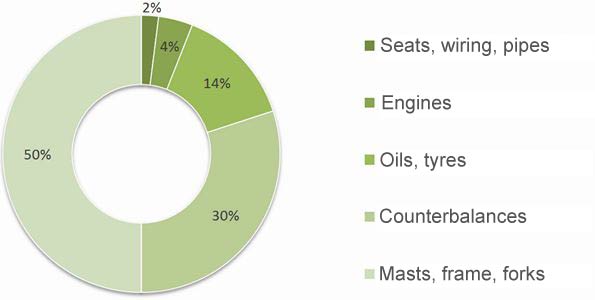
Oils, hydraulic fluids, batteries and other waste are recycled by authorised suppliers. When the forklift has to be disposed, it is sent to a scrapping to reprocess all materials so they can be used as another product's base, closing the circle.
ASEC
ASEC is a Toyota certificate which provides excellence standards regarding the customer services. It shares its philosophy with ISO 9001, which goal is to achieve a high quality standard, but it is more focused on dealers, stressing every aspect related to after sales service. This objective is achieved by improving efficiency and productivity. Certificate's applicability lasts for three years, meaning that we have to make an effort to improve and maintain all processes protocols so that we can be aknowledged as an ASEC supplier.
The ASEC's main objectives are:
ISO 9001
ISO 9001 is a combination of quality and management regulations. It has been developed by the ISO's Technical Comittee ISO/TC176 (Organización Internacional para la Estandarización) and specifies the requirements to ensure quality management that can be used internally on any organisation, to certify or with contractual purposes.
The eight ISO 9001:2008 chapters are:
ISO 14001
The three european facilities belonging to Toyota Material Handling have the ISO 14001 certificate. It is an internationally accepted regulation which determines how to establish an effective Environmental Management System. The directive is designed to reach an equilibrium between keeping the profitability and reducing the environmental impact.
It applies to those environmental aspects identified by the organisation as the ones that can be controlled and the ones that can be influenced. It does not specify by itself how to act regarding the environment.
The regulation can be applied to any organisation that wants to establish, implement, keep and improve an environmental management system, to ensure that itself complies with the environmental policy previously defined and to demonstrate the conformity with ISO 14001 by means of
OSHAS 18001
OHSAS 18001 (Occupational Health and Safety Assessment Series) sets out the minimum requirements for occupational health and safety management best practice, developed by the British Standards Institution (BSI) on OSHAS 18001 and OSHAS 18002.
Its main benefits are:
Quality and environment
Carretillas Barcelona, along with Toyota Material Handling, make efforts every day so that all processes are carried out in an efficient way and with a minimum environmental impact. To achieve this, standard procedures have been adopted ensuring a high quality service while taking care of the environment. Our commitment covers all processes from the initial design to the end of truck's life.
Sustainable from the beginning to the end
The new Tonero, equiped with internal combustion engine, shows up this commitment, raising the standards of performance and environmental responsability in material handling's industry. Every truck is manufactured in ISO 14001 certified facilities, ensuring a minimum environmental impact. Additionally, we require that all suppliers meet the same standards.
Toyota's engines are respectful with the environment and, at the same time, supply the needed power to accomplish its tasks. They comply with emissions' european directives and they produce even less polluting particles than those required by the regulations.
Toyota serie 8 is a 99% recyclable vehicle, minimalising the waste at the end of its life. Asbestos, mercury and cadmium have been completely supressed, while lead and hexavalent chromium quantities have been drastically reduced.
Oils, hydraulic fluids, batteries and other waste are recycled by authorised suppliers. When the forklift has to be disposed, it is sent to a scrapping to reprocess all materials so they can be used as another product's base, closing the circle.
ASEC
ASEC is a Toyota certificate which provides excellence standards regarding the customer services. It shares its philosophy with ISO 9001, which goal is to achieve a high quality standard, but it is more focused on dealers, stressing every aspect related to after sales service. This objective is achieved by improving efficiency and productivity. Certificate's applicability lasts for three years, meaning that we have to make an effort to improve and maintain all processes protocols so that we can be aknowledged as an ASEC supplier.
The ASEC's main objectives are:
• Ensure the aftersales service quality
• To create a norm which allows a comparative evaluations about different rendered services (customer's satisfaction indicators)
• Homogenize the aftersales network and establish a continuous improvement commitment
• To have audit programs providing training and advice
• Improve the service by using the Toyota Production System (TPS)
• Customer's satisfaction
• To know the strong points of Toyota's aftersales service, which means more efficiency when customer's needs arise
Carretillas Barcelona has been awarded with ASEC's certificate which takes into account 132 different operations from the aftersales and spare parts departments. Sections examined include facilites, training, safety, delivery processes, inventory, service's vehicles and equipment. This areas are thoroughly inspected and the corresponding reports are issued. Using these files, the certifying authority notify the deficiencies, with which action plans are developed to correct them so that the measures can be reevaluated to ensure the compliance.• To create a norm which allows a comparative evaluations about different rendered services (customer's satisfaction indicators)
• Homogenize the aftersales network and establish a continuous improvement commitment
• To have audit programs providing training and advice
• Improve the service by using the Toyota Production System (TPS)
• Customer's satisfaction
• To know the strong points of Toyota's aftersales service, which means more efficiency when customer's needs arise
ISO 9001
ISO 9001 is a combination of quality and management regulations. It has been developed by the ISO's Technical Comittee ISO/TC176 (Organización Internacional para la Estandarización) and specifies the requirements to ensure quality management that can be used internally on any organisation, to certify or with contractual purposes.
Structure
The ISO 9001:2008 is divided in eight chapters. First, second and third chapters are introductory. The other five are processes' oriented and they group the quality system requirements needed for its implementation.The eight ISO 9001:2008 chapters are:
- Scope.
- General.
- Applications.
- Normative references.
- Terms and definitions.
- Quality management system.
- General requirements.
- Documentation requirements.
- Management responsibility
- Management commitment.
- Customer focus.
- Quality policy.
- Planning.
- Responsibility, authority and comunication.
- Management review.
- Resource management
- Provision of resources.
- Human resources.
- Infrastructure.
- Work environment.
- Product realization
- Planning of product realization.
- Customer-related processes.
- Design and development.
- Purchasing.
- Production and service provision
- Control of monitoring and measuring
- Measurement, analysis and improvement
- General.
- Monitoring and measurement.
- Control of nonconforming product.
- Analysis of data.
- Improvement.
ISO 14001
The three european facilities belonging to Toyota Material Handling have the ISO 14001 certificate. It is an internationally accepted regulation which determines how to establish an effective Environmental Management System. The directive is designed to reach an equilibrium between keeping the profitability and reducing the environmental impact.
It applies to those environmental aspects identified by the organisation as the ones that can be controlled and the ones that can be influenced. It does not specify by itself how to act regarding the environment.
The regulation can be applied to any organisation that wants to establish, implement, keep and improve an environmental management system, to ensure that itself complies with the environmental policy previously defined and to demonstrate the conformity with ISO 14001 by means of
- a declaration and self commitment or
- looking for third parties confirmation interested in the organisation, such as customers, or
- looking for a third party confirmation through an external agent or
- looking for its environmental management system certificate/register emited by an external organisation.
OSHAS 18001
OHSAS 18001 (Occupational Health and Safety Assessment Series) sets out the minimum requirements for occupational health and safety management best practice, developed by the British Standards Institution (BSI) on OSHAS 18001 and OSHAS 18002.
Its main benefits are:
- Create the best posible working conditions across your organization
- Identify hazards and put in place controls to manage them
- Reduce workplace accidents and illness to cut related costs and downtime
- Engage and motivate staff with better, safer working conditions
- Demonstrate compliance to customers and suppliers

INSTAGRAM FEED
© 2020 Carretillas Barcelona, S.L.